
Our services
Porcelain Patio Installationin Newton Abbot, Torbay& Exeter
Outdoor porcelain laid on a primed full bed with tight, consistent joints, a patio that cleans with a brush and still looks new after five Devon winters.
30 years on the tools · Primed full-bed laying · £2 million public liability
30 years
Hands-on experience in Devon
5.0 rating
Average score on Google reviews
Fixed prices
Agreed in writing before we start
£2 million public liability
Fully insured, self-employed team covered
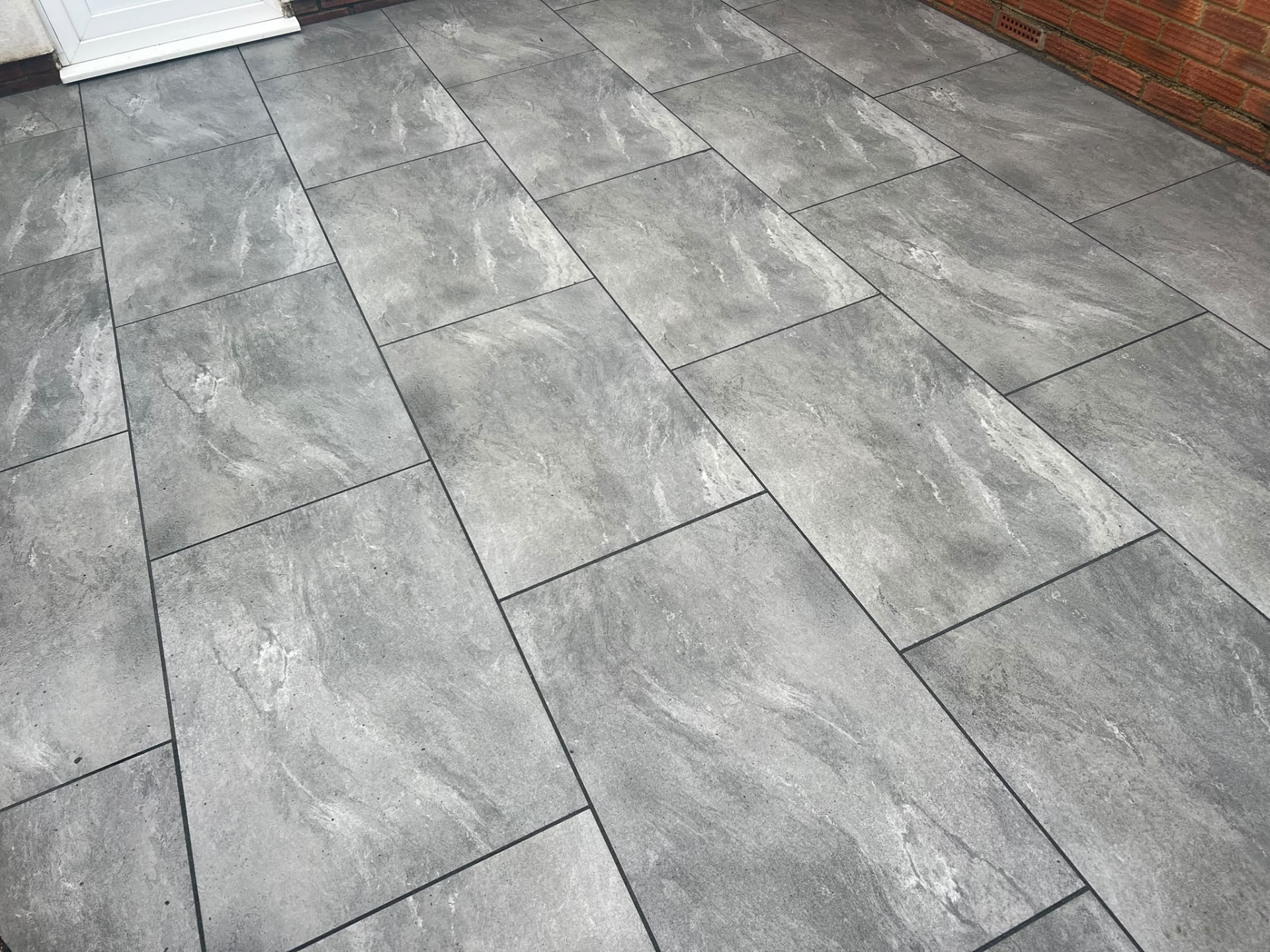
Outdoor porcelain patios laid on a primed full bed, with tight, consistent joints and a surface that cleans with a brush.
What porcelain paving is, and why people choose it
Outdoor porcelain is a fired, vitrified slab with almost no porosity. It doesn't absorb water, doesn't stain easily, doesn't need sealing and holds its colour instead of fading or greening the way some natural stone does in a shaded Devon garden.
Slabs are calibrated, which means every one is the same thickness and the same size to within a fraction of a millimetre. That gives you narrow, dead-straight joints and a flat, contemporary surface: provided the person laying it works to the same tolerance.
Who a porcelain patio suits
Porcelain is the usual choice for people who want to use the garden rather than maintain it: no sealing, no annual scrub-down, and moss and algae that lift off with a brush instead of establishing in the surface.
It works particularly well on modern and recently extended houses where bi-fold doors open onto the terrace, because the slab can be run to a matching internal tile and a level threshold detailed cleanly.
Why the laying method matters more than with any other paving
Porcelain has no absorbency at all, so it will not bond to a mortar bed on its own. It needs a slurry primer on the back of every slab. Skip that step and the slabs release from the bed over the first year, the single most common porcelain failure we get called to.
Because the material is perfectly flat, any unevenness in the bedding shows as a lipped edge you feel through your shoe. Spot-bedding on five dabs of mortar leaves voids that crack the slab under load. Both are avoidable, and both are why a porcelain patio should never be priced like a slab patio.
What's included
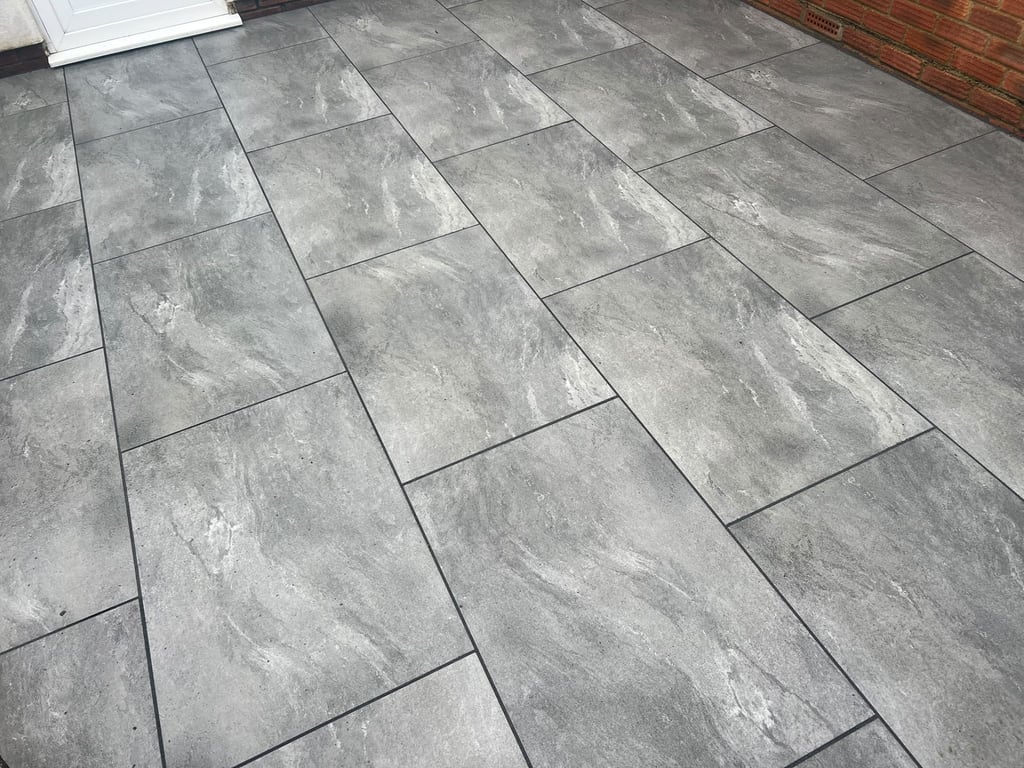
- Slurry-primed, full-bed laying for every slab
- Tight, consistent joints in the correct exterior grout
- Slip-rated surfaces suitable for shaded Devon gardens
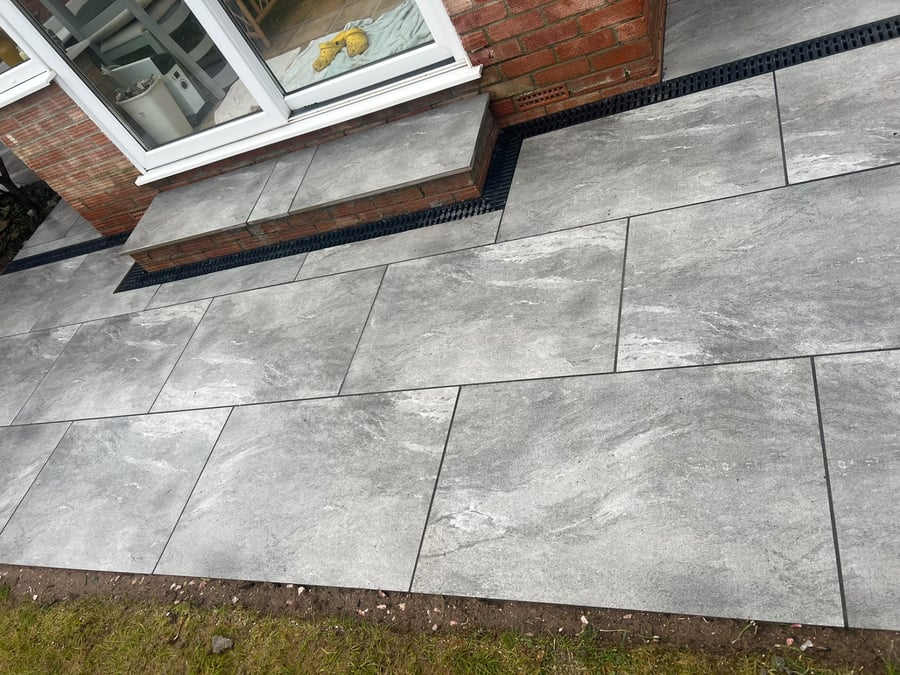
- Porcelain steps, copings and edge trims cut to match
What it costs to leave it
Slabs debond without a primer
Unprimed porcelain simply does not stick. The patio looks perfect on handover and starts to sound hollow, then rock, within a year or two.
Spot bedding cracks the slab
Mortar dabs leave voids beneath the slab. Put a table leg or a heel over one and a slab that cost a lot of money cracks straight across.
Lipped joints in a flat material
Porcelain is unforgiving: a millimetre of bedding error is visible, catches the light, and catches toes on the way to the back door.
The common mistake: buying porcelain, paying for slab-patio labour
The material premium is only half the job. Priming, full bedding and precise setting out take longer, and a quote that doesn't reflect that is quietly leaving something out.
How the job runs
- Step 1
Site visit, measure and slab selection
Phil measures the area, checks levels and thresholds, and talks through slab size, finish and slip rating for how shaded and exposed your garden is.
- Step 2
Fixed price and setting out
You get one fixed price from measured area and labour, plus a setting-out plan so the full slabs land where they're seen and the cuts land where they aren't.
- Step 3
Excavation, sub-base and falls
We dig out to depth, remove spoil, then lay and compact the sub-base in layers with falls set to carry water away from the house.
- Step 4
Priming, full-bed laying and grouting
Each slab is back-primed with slurry and set on a full mortar bed, levelled to its neighbours, then joints are filled with a proper exterior porcelain grout.
- Step 5
Handover
We clear the site, walk the finished work with you and explain any aftercare. If anything needs attention afterwards, Phil is the person who answers the phone.
What you get out of it
Almost no maintenance
No sealing, no annual treatment, a brush and occasional wash keeps a porcelain terrace looking as it did on day one.
Colour that stays put
Fired-through colour doesn't bleach in sun or green over in shade the way some natural stone does.
Flat, contemporary lines
Calibrated slabs and precise bedding give narrow, straight joints and a genuinely level surface.
Indoor-outdoor continuity
Matching internal and external tiles with a level threshold, where the doors and damp-proof course allow it.
Built not to debond
Every slab back-primed and full-bedded, because that's what porcelain requires.
Formats, finishes and slip ratings
The slab you pick changes the look, the cutting and how the patio behaves in a wet Devon November.
- Large-format slabs: 900x600 and larger, fewer joints, a calm contemporary surface; needs a very flat base and careful handling.
- Plank and linear formats: timber-effect boards that give the look of decking with none of the maintenance.
- Stone-effect and concrete-effect finishes, the texture of riven stone or poured concrete in a material that doesn't stain.
- Slip rating: R11 and above is worth having on shaded terraces, steps and anywhere that stays damp under trees.
- Matching copings, steps and bullnose, so the patio edge, the step nosing and the wall top all read as one piece of work.
Cutting, drainage and detailing
Porcelain is cut wet with a diamond blade. Clean cuts around drains, manholes, door thresholds and curved edges take time and are part of what you're paying a tradesman for, a chipped edge on a large slab means replacing the slab.
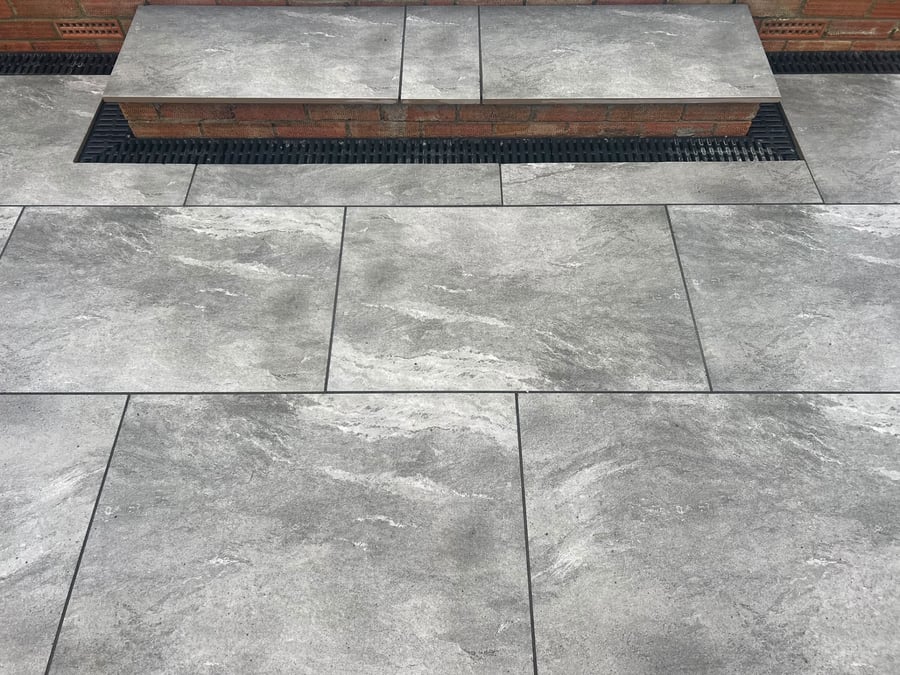
Recessed manhole covers can be infilled with the same porcelain so inspection chambers disappear into the pattern instead of interrupting it.
Falls are set at the sub-base stage. Because porcelain is impermeable, all surface water runs off it, so where that water goes, a channel drain, a gravel margin, a soakaway, is decided before laying rather than after the first downpour.
Examples of our work
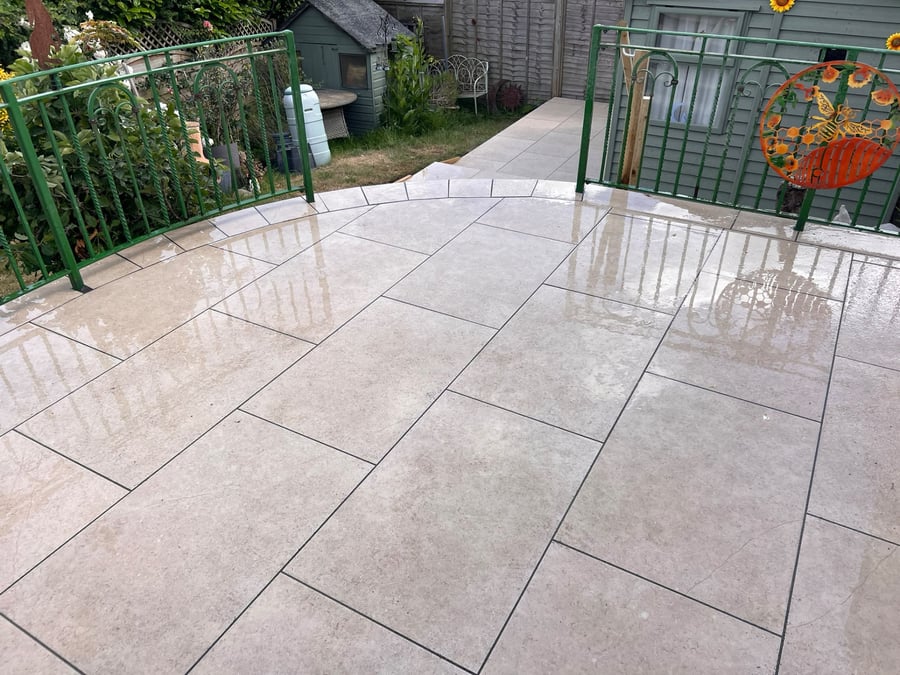
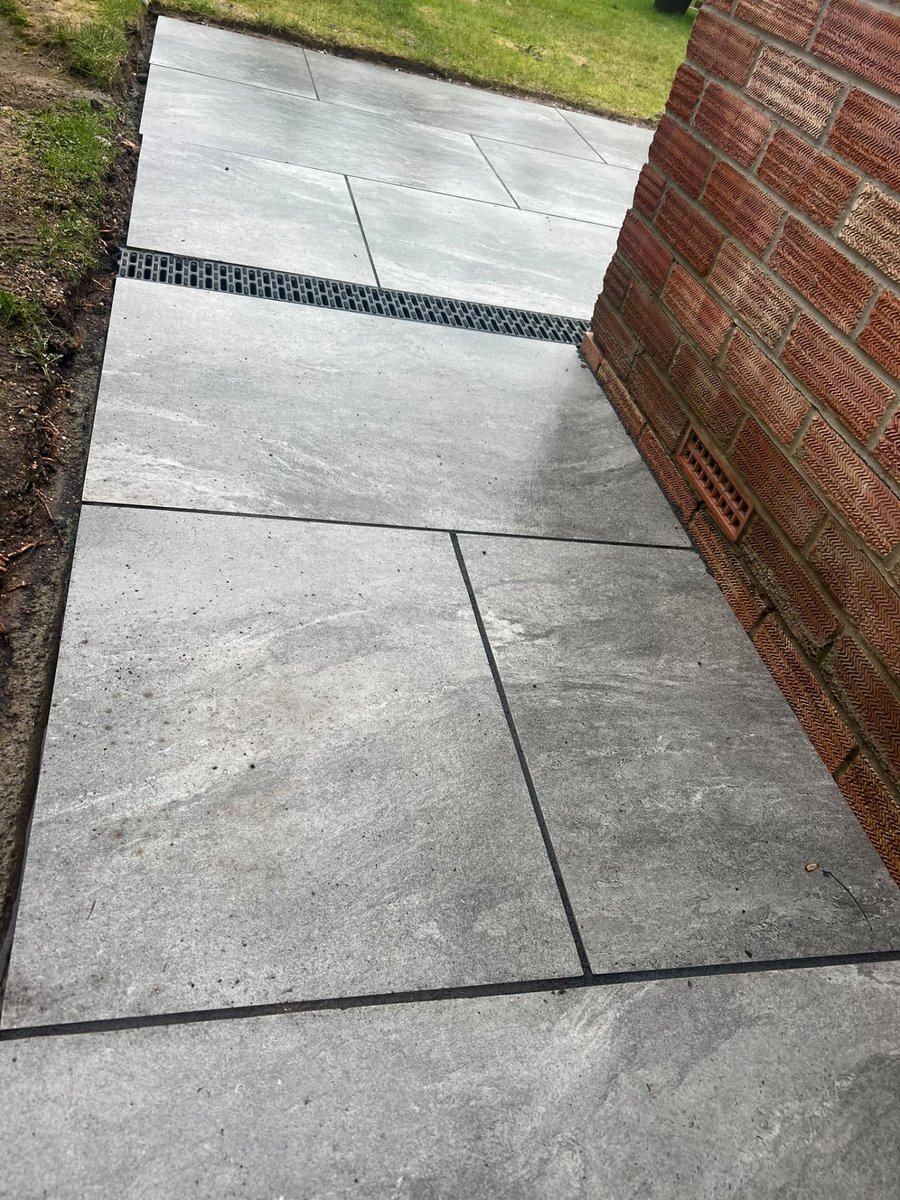
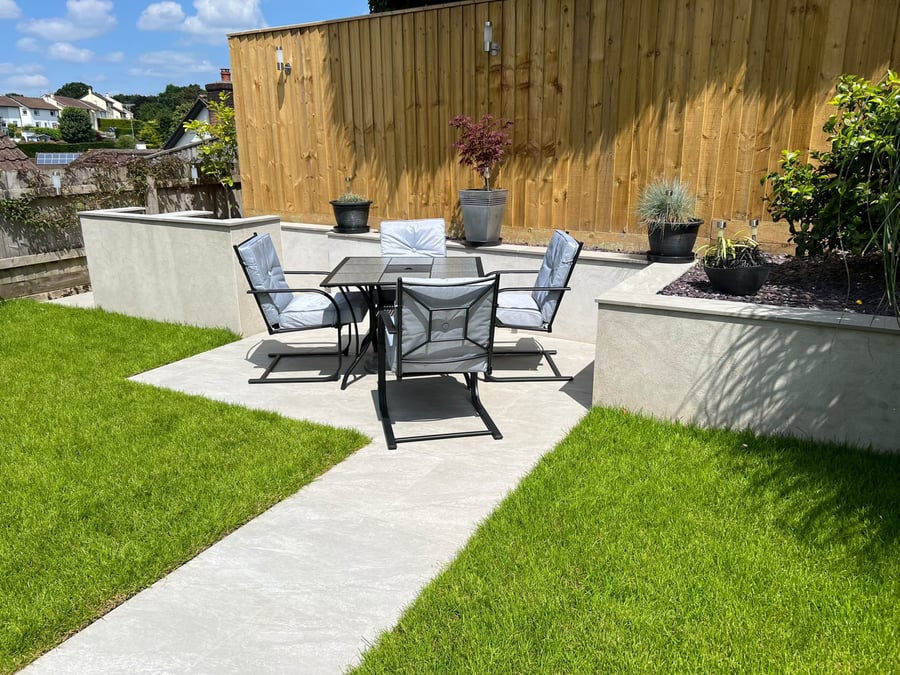
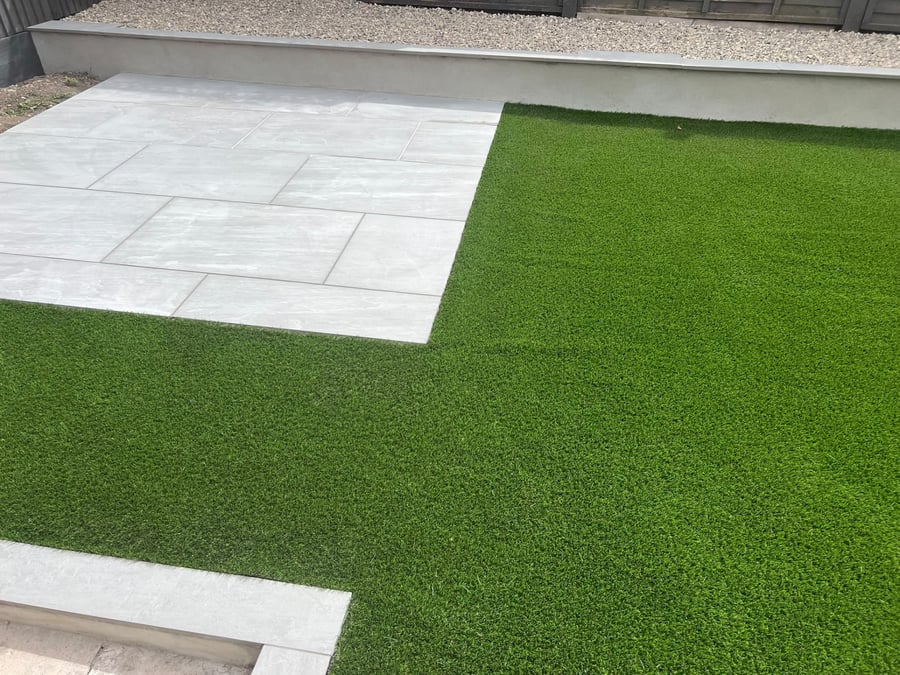
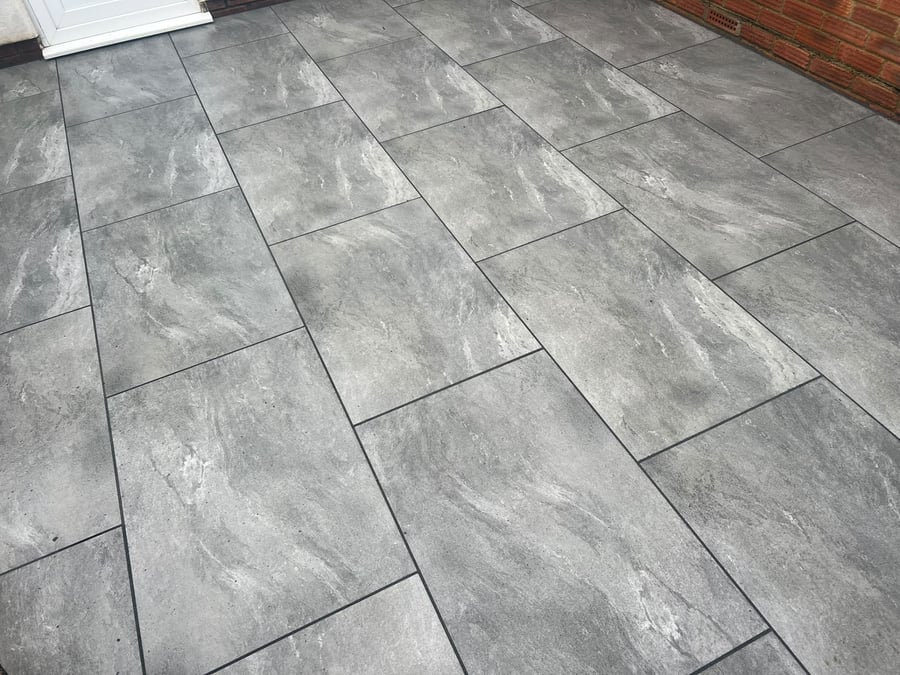
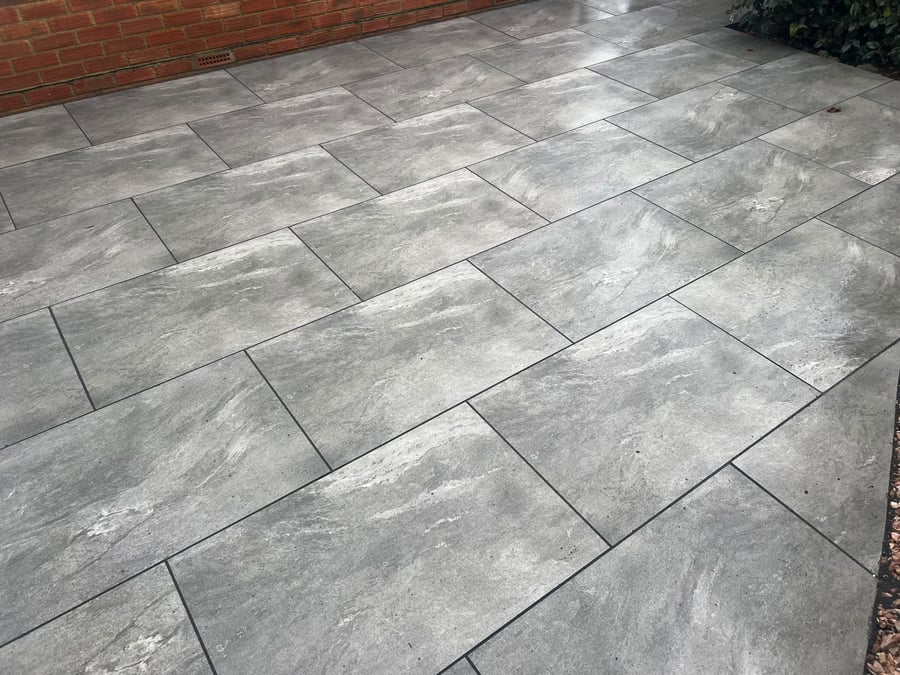
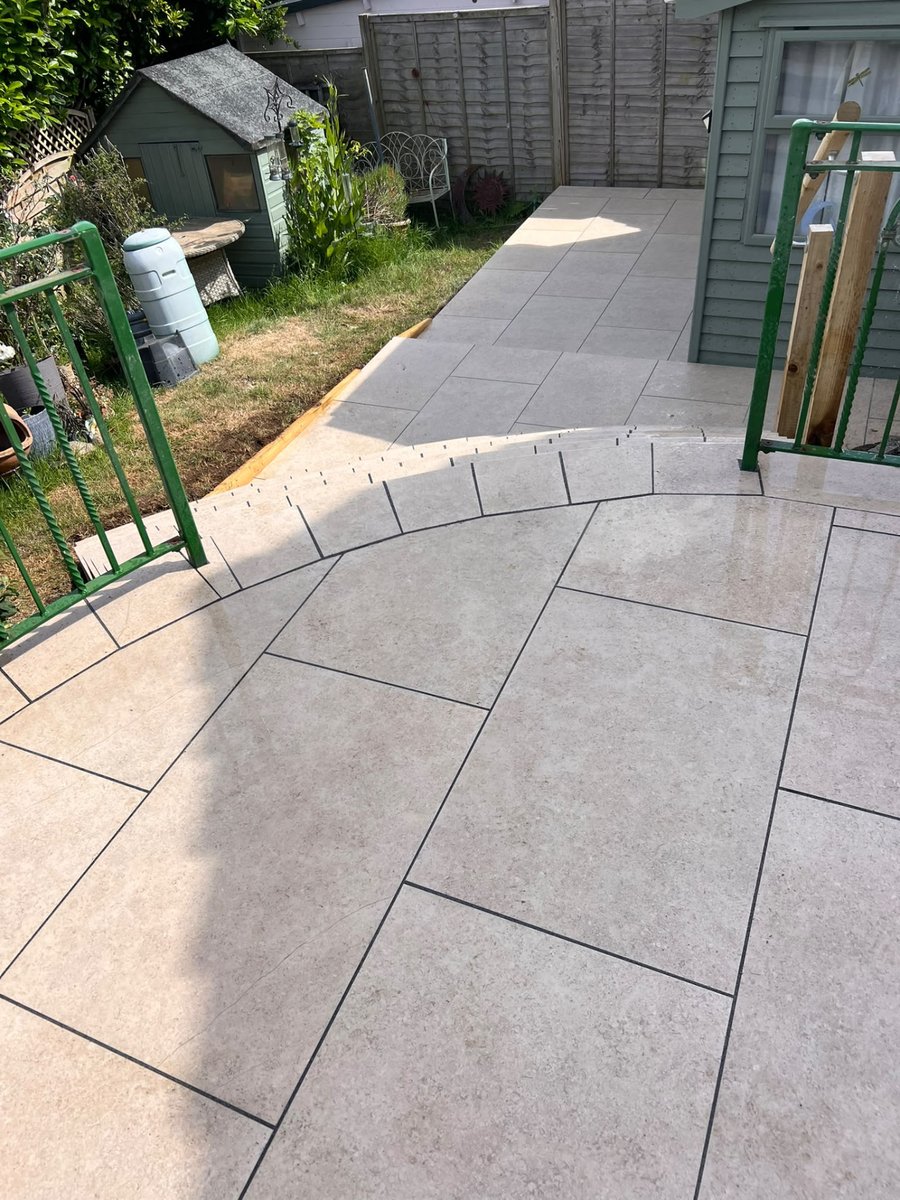
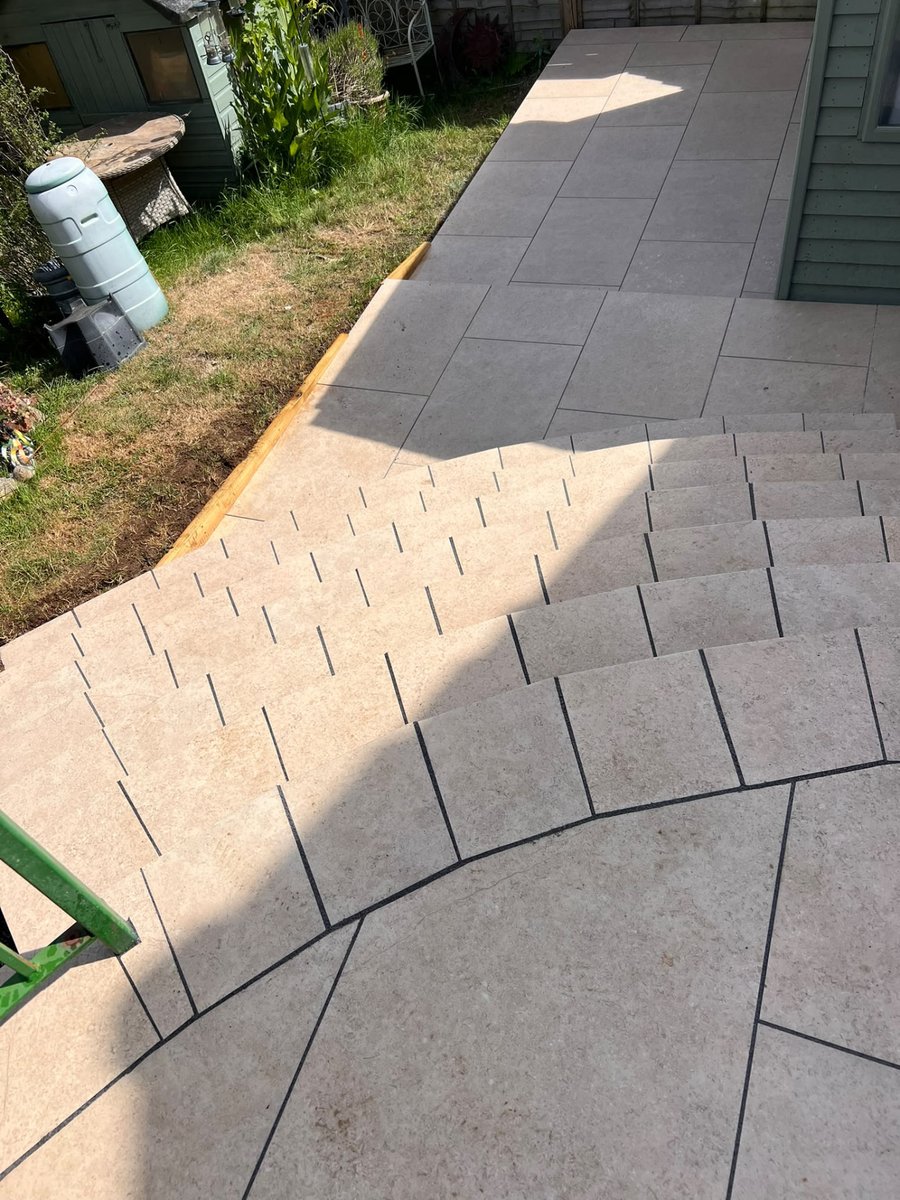
Slide through photos of finished projects across South Devon.
Where we do this work
Related services
Back to the PC Landscaping homepage, see all services or get in touch with Phil.
Porcelain Patios: common questions
How much does a porcelain patio cost?
It depends on area, slab format, excavation depth, drainage and how much cutting the layout needs. Phil measures on site and gives one fixed price covering the whole job.
Is porcelain better than natural stone?
It's different. Porcelain wins on maintenance, colour stability and flatness; Indian sandstone wins on warmth, texture and how it sits with an older property. Phil will tell you honestly which suits your house.
Does porcelain get slippery?
Any wet outdoor surface can. Choosing a slab with a proper outdoor slip rating and keeping falls and drainage right makes the difference, especially on shaded Devon terraces.
Does porcelain paving need sealing?
No. It's vitrified, so it doesn't absorb. The grout joints are what benefit from the correct product at installation, and we use an exterior porcelain jointing compound rather than sand.
Can porcelain be laid over an existing patio?
Only if the existing base is genuinely sound and the levels work, which is rare. Most of the time we lift the old surface and build a base that will hold porcelain flat.
Why does porcelain need priming?
Because it has no porosity, mortar has nothing to grip. A slurry primer on the back of every slab creates that bond. Without it the slabs eventually lift off the bed.
Where do you lay porcelain patios?
Across Teignbridge, Torbay, Exeter and the South Hams, from our base in Denbury near Newton Abbot.
Client feedback
Recent words from South Devon gardens
“Phil finished the remainder of my featherboard fence. Started the job promptly, arrived on time and finished the job professionally.”
Big Steve
Featherboard fencing · Google review
“Fitted our hardwood deck and it looks great! Decent price and took just a couple of days plus they cleaned up after themselves.”
Steve Marson
Hardwood decking · Google review
“Phil and Nigel did a complete redesign of our garden, did a very professional job from start to finish… this is the second job they have done for us and we have another project for later in the year.”
Robert Down
Full garden redesign · repeat client · Google review
“Fab job for my pathway around my house and patio… Phil's suggestion and explanation of the construction work was the most solid.”
Hung Alice
Pathway & patio · Google review
Get a fixed price for your porcelain patio
Phil visits, measures, talks through slab formats and drainage, and gives you one fixed figure before anything starts.
30 years' experience · £2 million public liability · 8am–6pm, Monday to Friday